Last updated 2026-08-19
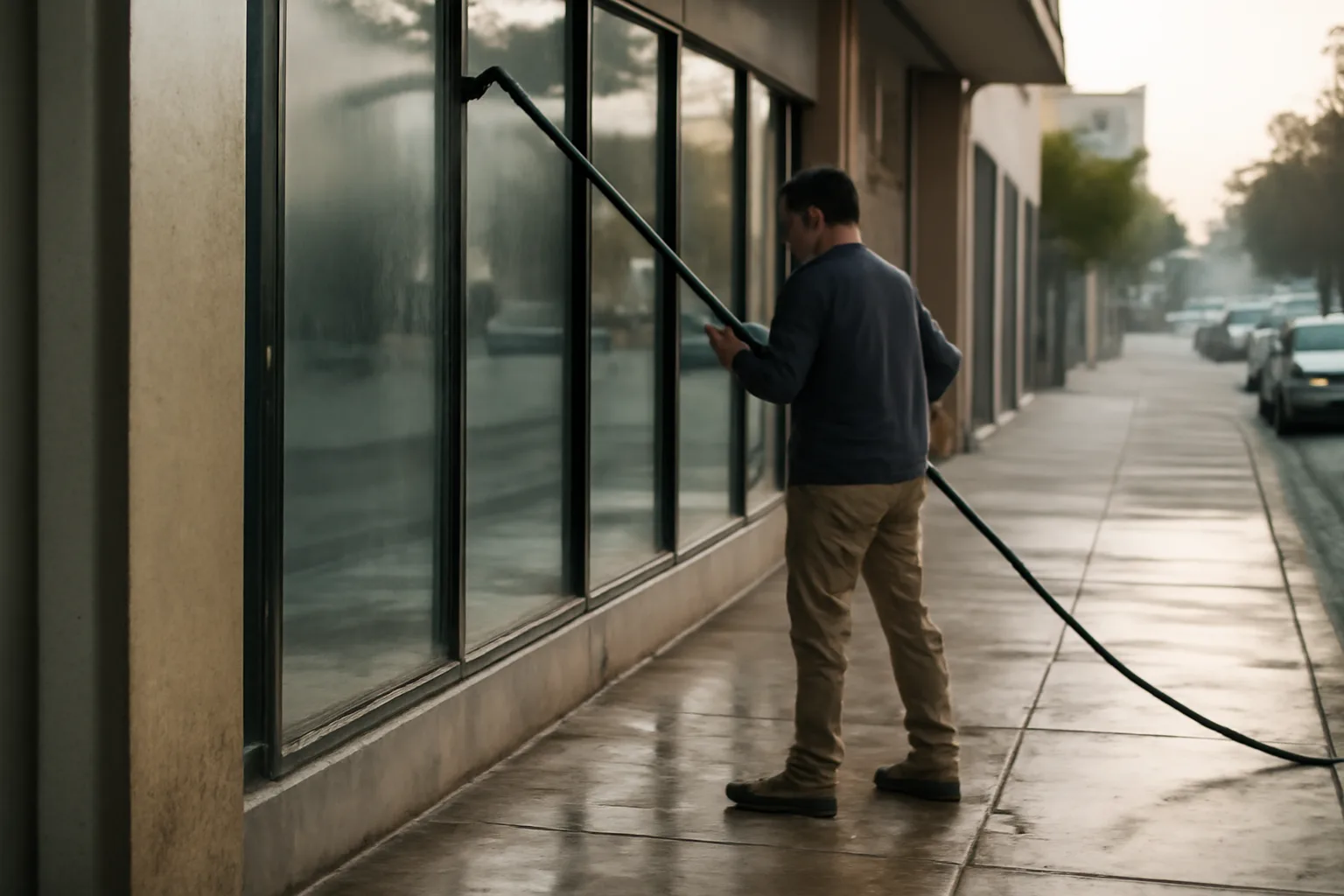
TL;DR
California has no single storefront windows board. Washing existing storefront glass is a city business tax plus Cal/OSHA rules, not a CSLB license. Install or repair glass at $500 or more and you are in contractor territory, usually C-17. Confirm current fees and processing with CSLB, your city, the Secretary of State, and FTB.
Do you need a license for storefront windows in California?
Most wash-only operators don't need a Contractors State License Board license for storefront windows in California. There is no state card for washing glass. You do need local business paper, and you need CSLB the moment you install, replace, or repair storefront glass or frames on a job that doesn't fit the minor-work exemption.
Business and Professions Code 7026 is the contractor definition. It covers construction, alteration, and repair of structures and fixtures. It doesn't read like a janitorial statute. [1]
The dollar line everyone quotes is real. Business and Professions Code 7048 sets the contractor-license floor at $500 for a single undertaking. The statute says the chapter "does not apply to any work or operation on one undertaking or project by one or more contracts, the aggregate contract price for which, including labor, materials, and all other items, is less than five hundred dollars ($500)." Later sentences add conditions, including a bar on using the exemption when the work is part of a larger project. Read the full section before you lean on it. [2]
Cities tax the privilege of doing business. If you hire, Labor Code 3700 requires workers' compensation. [7] If you use a trade name, BPC 17910 points you at a county fictitious business name filing. [12]
I wouldn't apply to CSLB for a sidewalk pole route. I'd apply the day a scope includes setting glass, reworking frames, or a property-manager template that truly is a construction contract. When that line is fuzzy, call CSLB and get the answer in writing.
Is there a storefront windows board in California?
No. California runs no agency named a storefront windows board. Search results hint at one because other states park trades under a single contractor board. California splits the work across several offices.
CSLB licenses contractors. The Division of Occupational Safety and Health writes window cleaning safety orders in Title 8. The Secretary of State files entities. FTB taxes them. Cities and counties collect business tax. EDD shows up when you have employees.
Wash existing glass and your real counter is the city finance office, not Sacramento. Build or repair storefront systems and CSLB is the board that can cite you for unlicensed contracting under BPC 7028. [13]
That scatter is normal. Readers checking storefront windows board in Arizona or storefront windows board in Colorado find a contractor board plus local tax, not a window-washing guild. Same story, different letterhead.
Decide which activity you sell. Washing and installing are different businesses on California paper. Don't apply to the wrong office because a forum used the word board.
How much does storefront windows cost in California?
Nobody publishes an official California price for washing or installing storefront glass. Treat any single statewide average from a forum as marketing, not a government series.
Startup paper is the part you can pin down. The Secretary of State lists the Articles of Organization fee for an LLC on its business entity filing fees page (long posted at $70; confirm the live schedule before you pay). [9] Revenue and Taxation Code 17941 imposes an $800 annual tax on limited liability companies doing business in California. First-year treatment has changed by statute more than once. Confirm the current tax year with FTB before you form just to dodge a bill. [8]
City business tax isn't one number. Gross-receipts cities and flat-fee cities don't land in the same place. I won't invent Los Angeles or San Jose's current bracket. Pull that city's live business tax table.
Need CSLB? Budget an application fee, exam fees, an initial license fee, and the $25,000 contractor bond in BPC 7071.6. [3] CSLB posts current fee amounts. Confirm them. I'm not going to guess a 2026 fee table.
Insurance will likely dwarf your filing fees. I have no honest public data set for window-cleaner premiums in California, so get quotes. Ask about additional-insured endorsements. Malls require them.
Customer pricing follows labor and access. DIR posts the statewide minimum wage and it moves. Confirm the current rate on the DLSE minimum wage FAQ before you build a wage model. [10] Parking, water, and height change a quote more than a mythical per-pane average.
A ground route doesn't need a shop full of lifts. A water-fed pole and clean resin get you paid. StorefrontWash sells a $149 one-time Pure-Water Pole Route Kit if you want that start in one box. A hardware-store build is fine too. Spending on wraps and radios in month one is usually a waste.
How long does storefront windows take in California?
A storefront wash stop can take minutes or most of an hour. Frontage, film, and whether you return to rinse set that clock. None of that is a board timeline.
Paper is slower, and it isn't one queue.
City business tax certificates often issue in days once the form and payment clear. Some cities take longer. Confirm with the city that has jurisdiction over your base and, if they claim it, over the route.
SOS entity filings are usually faster online than by mail. Confirm current processing on the Secretary of State's business entities pages. [9] Don't promise a client an LLC number on a Friday because a blog said 24 hours.
A CSLB license, if you need one, is the long pole. Experience affidavits, the law and business exam, the trade exam, and whatever backlog the board is running all sit on that path. BPC 7068 is the qualifications statute. [14] I won't invent a week count. Confirm processing with CSLB the week you apply.
Cal/OSHA window orders come with no waiting period. They apply when the work matches the definition. [5][6]
If a bid sheet demands a license number, don't schedule the first wash until the issuing office has actually produced paper. No publisher can guarantee California timing.
When does washing become a CSLB contracting job?
Washing glass that's already in the opening doesn't match the contractor definition in BPC 7026. Installing the glass does. [1]
You cross into CSLB territory when the scope is construction, alteration, or repair, and the job doesn't fit BPC 7048's minor-work exemption. [2] Replacing a blown insulated unit, rebuilding an aluminum storefront, or setting a new entry system is glazing work. I'll swap that cracked pane while I'm here is how wash routes wander into unlicensed contracting.
BPC 7028 makes unlicensed contracting a crime. The civil problem is payment. Courts can block recovery if you needed a license and didn't have one. [13]
Some owners require a contractor number on every vendor, including janitorial. That's their template. It isn't a new statute. You can walk away, or you can get licensed if the account is worth the bond and the exams.
Use a clean scope of work. Write that you clean existing exterior glass only, with no glazing, no frame repair, and no seal replacement. Keep that language on the invoice.
| Activity | Usually need CSLB? | Main paper | Confirm with |
|---|---|---|---|
| Wash existing storefront glass | No | City tax, FBN, liability insurance | City finance, county clerk |
| Replace glass or frames at $500 or more | Yes, typically C-17 | CSLB license and $25,000 bond | CSLB |
| Public agency building contract | Often, plus wage rules | DIR public works compliance | DIR and the awarding body |
| Sell bottles or tools on the route | No | CDTFA seller's permit if you sell tangible goods | CDTFA |
What does a C-17 glazing license actually cover?
C-17 is CSLB's glazing classification. It isn't a washing license.
CSLB's Description of Classifications says a glazing contractor "selects, cuts, assembles and/or installs all makes and kinds of glass, glass work, mirrored glass, and glass substitute materials for glazing." The same write-up covers frames, panels, sashes, and doors. [4] That's storefront construction language, not a squeegee.
Original license qualification sits in BPC 7068. Most applicants show four years of journeyman-level experience and pass the exams CSLB assigns. [14] Confirm the current exam pair and any waivers with the board. I won't invent pass rates.
Business and Professions Code 7071.6 requires a $25,000 contractor bond as a condition of a CSLB license. [3] Confirm the live bond amount and accepted surety process with CSLB before you pay a broker.
Sell only washing and C-17 is a waste of money. Advertise storefront glass replacement and you want C-17 before you bid work at $500 or more. Mixing both trades on one unlicensed invoice is the pattern CSLB actually cares about.
What do Cal/OSHA window cleaning orders require?
Cal/OSHA, inside the Department of Industrial Relations, writes the window cleaning safety orders in Title 8. Section 3281 defines the activity. Section 3282 sets general requirements. [6][5]
The series was built around people leaving the ground: belts, boatswain's chairs, anchors, and building-side gear. A water-fed pole used from the sidewalk often won't match every sentence in that subchapter. Read the definitions anyway. Whether your method is window cleaning under the orders is a definition question, not a marketing one.
I'm not going to paraphrase 20 sections into a cheat sheet that drifts from the text. Open 3281 and 3282 and read them. Building managers sometimes demand suspended-access certificates on a ground-pole scope. The order in front of you is how you answer.
Take sill work, ladders at height, or descent gear later and stop improvising. Training and fall protection become the job. California employers also need an Injury and Illness Prevention Program under 8 CCR 3203. [11]
Train a helper? Document it. Cal/OSHA interviews after a fall won't accept they watched me once. I wouldn't take a second-story sill job in year one. The money isn't worth the orders you haven't practiced.
High work is a different company than a strip-mall pole route. Price it that way or decline it.
What paper should you file before the first paid stop?
For a wash-only route I'd file this, in this order.
City or county business tax certificate for the place you operate from. Ask each city on a recurring route whether they also claim you. California has no statewide general business license, so this local certificate is the operating paper most inspectors actually ask to see.
A fictitious business name if you trade as anything but your personal legal name or the exact SOS entity name. BPC 17910 is the filing duty. You file with the county clerk and complete the publication the county specifies. [12]
An SOS entity filing only if you want an LLC or corporation. Use the live fee schedule. [9] Then deal with FTB and the $800 LLC tax question. [8]
EDD and payroll accounts only when you have employees.
A CDTFA seller's permit only if you sell tangible goods. Pure service often doesn't need one. Confirm with CDTFA if you bundle product.
Insurance certificates in the names property managers use on their vendor packet.
Skip a CSLB number if you aren't licensed and aren't doing contractor work. Printing a number you don't have is a worse problem than printing none.
California operators get cited for missing city tax and for bad contractor labeling far more than for skipping a fictional state window board.
How do city and county business taxes work?
City tax is the friction, not a state board interview.
Los Angeles, San Francisco, San Diego, San Jose, and a few hundred other cities each write their own business tax. Some use gross receipts. Some use a flat certificate. I won't invent a current bracket. Download that city's current business tax document.
Unincorporated county areas sit with the county. A county fictitious business name doesn't replace a city certificate inside city limits.
Charter cities sometimes argue that a regular route is doing business even when your LLC sits somewhere else. Get the city's answer in writing if you plan to ignore them. I wouldn't ignore them.
Some cities want a state tax ID or a local emergency contact on the application. Have your SOS number and a real mailing address ready. A PO box isn't always accepted. Confirm that city's rules.
Run multi-metro routes and you budget a folder per city. That's dull. It's also how you stay in business. People comparing paper in Florida or Illinois hit the same local-tax pattern.
Home occupation rules can bite if you park a van and store poles at a house. Check zoning. I've seen cities care about that and not care about your squeegee technique.
Do you need workers' comp and EDD accounts?
No employees, and you generally aren't the employer Labor Code 3700 is talking about. That statute requires employers to secure workers' compensation. [7] Confirm with a broker before you assume a policy is optional. Some property owners still demand a waiver or a policy as a condition of the vendor packet. That's contract, not the Labor Code.
Helpers you call subcontractors are where people get hurt. Labor Code 2775 sets California's ABC test for employment status. [15] If the person only works your route, with your pole, on your schedule, you're probably an employer. Register with EDD, withhold, and put workers' comp in force before they step onto a lot.
DIR won't care that the work is just windows.
Minimum wage and overtime still apply to employees. Confirm current DIR figures. [10] 8 CCR 3203 IIPP duties attach to employers. [11]
I wouldn't hire in month one unless the route is already overflowing. Payroll compliance costs more than a missed stop.
What would I file in year one, and what would I skip?
I'd keep year one small.
Stay a sole proprietorship, or form an LLC only after you run the $800 tax math with FTB for the current year. [8] Get the city certificate. File the FBN if the trade name needs it. Buy a real general liability policy. Write scopes that say you clean existing glass only.
Skip CSLB. Skip a warehouse. Skip a helper.
Read Title 8 sections 3281 and 3282 once and keep the pages in the vehicle. [5][6]
Don't print licensed and insured if you only mean insured.
If a client wants glass replacement, refer a C-17 or go get that classification first. [4]
Other states package this as one board packet. California doesn't. For the same kind of walkthrough, see storefront windows board in Hawaii, Alaska, Georgia, and Connecticut.
Want a simple kit path after the paper? Use /start. Confirm every fee and form with the agency that issues it. This site is a reference, not your lawyer and not your registrar.
What mistakes get California wash routes cited?
The $500 line isn't a monthly loophole you can slice without reading BPC 7048's project language. [2]
Licensed and insured on a magnet, with no license, is how you write your own complaint.
A water-fed pole doesn't erase Title 8 the day you put someone on a sill. [5]
A Wyoming LLC doesn't erase a California city's business tax on a Hollywood Boulevard route.
A single helper who isn't really independent fails Labor Code 2775 and then fails Labor Code 3700. [15][7]
Public building work can drag you into prevailing wage. Ask DIR and the awarding body before you treat a city hall lobby like a yogurt shop.
Confirm every variable number with the board or city that owns it. Fees move. Processing moves. Statutes get amended. This page is current as a map, not as a fee quote.
Frequently asked questions
Do you need a license for storefront windows in California?
Wash-only work on existing glass usually needs local business tax paper, not a CSLB license. Install or repair storefront glass at $500 or more and you typically need a CSLB classification such as C-17. Confirm edge cases with CSLB. Cities still require their own certificates even when Sacramento does not.
How much does storefront windows cost in California?
There is no official state price for the service. Startup paper is often an SOS filing (confirm the live LLC fee, long posted at $70), a possible $800 LLC tax, and a city certificate. CSLB, if required, adds board fees plus a $25,000 bond. Customer rates follow labor and access, not a state schedule.
How long does storefront windows take in California?
A wash stop is usually minutes to about an hour. City certificates are often days, not months. SOS online filings are often faster than mail. A CSLB license, when required, is the slow step because of experience proof and exams. Confirm current processing with each office. Nobody can honestly guarantee a date.
Is there a California storefront windows board I apply to?
No. California runs no board by that name. CSLB licenses contractors. Cal/OSHA writes window cleaning safety orders. Cities collect business tax. FTB and the Secretary of State handle entities. Apply to the office that matches the work you actually sell, not to a title you saw in a search result.
Does washing storefront glass require a C-17 license?
Usually no. C-17 is CSLB's glazing classification for selecting, cutting, assembling, and installing glass and frames. Cleaning glass already in the opening is not what that classification describes. Replacement and frame work is. Confirm with CSLB if a bid mixes washing and repair on one contract.
Do I need workers' comp as a solo window cleaner?
Labor Code 3700 requires employers to secure workers' compensation. A true solo operator with no employees is generally not in that bucket, but property owners may still demand a policy or waiver in the contract. Confirm with a broker. The day you hire, the statute applies.
Does the $500 CSLB exemption cover a monthly route?
Not automatically. BPC 7048 is about one undertaking under $500, with conditions that block using the exemption as a slice of a larger project. A standing monthly account can look like one project. Read the full section and ask CSLB if your contract structure is close to the line.
Do I need a seller's permit to wash windows?
Pure window washing is a service. CDTFA seller's permits apply when you sell tangible personal property. If you only bill labor, you often do not need one. If you sell bottles, blades, or film, ask CDTFA. Do not guess from a forum post or copy another washer's permit number.
What Cal/OSHA rule covers water-fed poles?
Title 8 sections 3281 and 3282 are the starting window cleaning orders. They were written around building-side methods, so a sidewalk pole may not trigger every sentence. Height, ladders, and descent gear change the analysis. Read the definitions. Do not assume a pole is a free pass.
Can a city shut me down without a business tax certificate?
Cities can cite, fine, and make it hard to keep commercial accounts if you skip their business tax certificate. California has no statewide general business license, so the city (or county in unincorporated areas) is the office that actually checks. Ask each city on the route.
Do I pay the $800 LLC tax in year one?
Revenue and Taxation Code 17941 imposes an $800 annual LLC tax. First-year treatment has been amended more than once. I will not invent the 2026 first-year rule. Confirm the current taxable year with FTB before you file articles just to save a tax.
What if I also replace broken storefront panes?
Replacement is glazing, which is contracting. If the job does not fit BPC 7048, you generally need a CSLB C-17 license and the $25,000 bond. Do not hide replacement lines on a wash invoice. Refer the work or get licensed first, then bid the repair as its own job.
Do malls and HOAs require extra insurance?
Often yes. That is contract, not a state board rule. Expect additional-insured endorsements, certificate holders named a certain way, and sometimes higher limits than you would buy on your own. Get the vendor packet before you bid. I would not start the route on a handshake.
Is bonding required if I only clean glass?
The $25,000 CSLB contractor bond in BPC 7071.6 attaches to a contractor license, not to a wash-only city certificate. Property owners can still demand a commercial bond in their vendor terms. Read the packet. Do not confuse an owner-required bond with a CSLB bond.
Sources
- California Legislative Information, Business and Professions Code 7026: BPC 7026 defines a contractor as a person who undertakes construction, alteration, or repair work, which is the statutory hook for CSLB licensing.
- California Legislative Information, Business and Professions Code 7048: BPC 7048 exempts a single undertaking under $500 in aggregate contract price from the Contractors' State License Law, with conditions.
- California Legislative Information, Business and Professions Code 7071.6: BPC 7071.6 requires a $25,000 contractor bond as a condition of issuing or maintaining a CSLB license.
- CSLB, Description of Classifications (C-17 Glazing): CSLB describes a C-17 glazing contractor as selecting, cutting, assembling, and/or installing glass, glass substitutes, and related frames, panels, sashes, and doors.
- California DIR, Title 8 section 3282 Window Cleaning General Requirements: 8 CCR 3282 sets Cal/OSHA general requirements for window cleaning operations.
- California DIR, Title 8 section 3281 Window Cleaning definitions: 8 CCR 3281 defines window cleaning for purposes of the Cal/OSHA window cleaning safety orders.
- California Legislative Information, Labor Code 3700: Labor Code 3700 requires employers to secure workers' compensation coverage.
- California Legislative Information, Revenue and Taxation Code 17941: RTC 17941 imposes an $800 annual tax on limited liability companies doing business in California.
- California DIR DLSE, Minimum Wage FAQ: DIR publishes the current statewide minimum wage and related rules on the DLSE minimum wage FAQ.
- California DIR, Title 8 section 3203 Injury and Illness Prevention Program: 8 CCR 3203 requires California employers to establish and implement an Injury and Illness Prevention Program.
- California Legislative Information, Business and Professions Code 17910: BPC 17910 requires a fictitious business name statement when a person transacts business under a name other than the person's own.
- California Legislative Information, Business and Professions Code 7028: BPC 7028 makes it unlawful to engage in contracting without the required CSLB license.
- California Legislative Information, Business and Professions Code 7068: BPC 7068 sets CSLB license qualifications, including the experience showing required of most original applicants.
- California Legislative Information, Labor Code 2775: Labor Code 2775 sets California's ABC test used to decide whether a worker is an employee or an independent contractor.