Last updated 2026-08-19
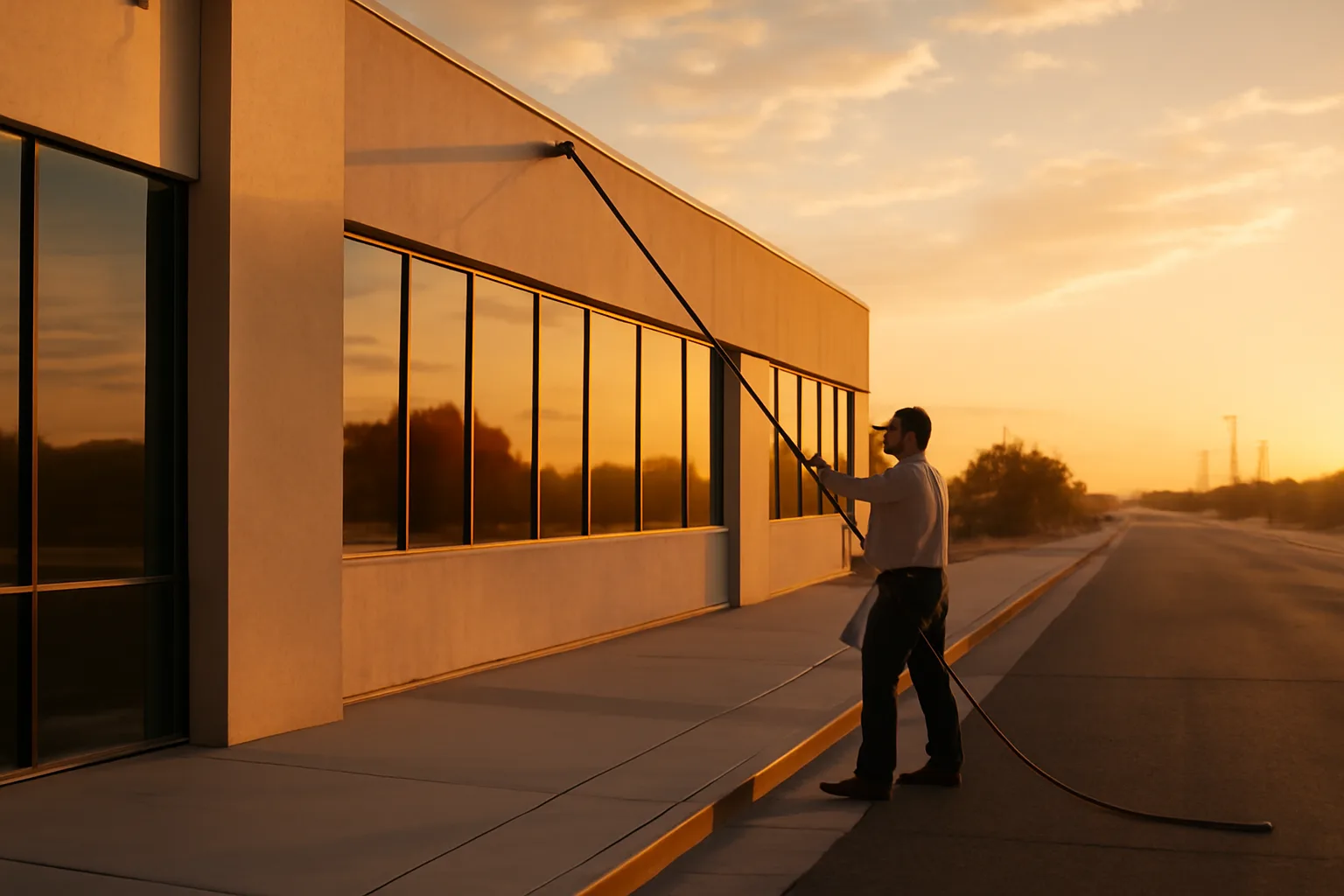
TL;DR
Washing storefront glass in Arizona is maintenance, so you usually skip an ROC contractor license. You still form the entity, ask AZDOR about a tax account, and renew city privilege licenses where you work. The state sets no job prices. A single-story retail face often takes well under an hour. Confirm every fee on the current board pages.
Do you need a license for storefront windows in Arizona?
If you only wash glass on existing storefronts, you usually do not need an Arizona Registrar of Contractors license. Arizona contractor law targets construction work, not routine cleaning. You still need ordinary business paper: an entity or trade name, tax accounts if they apply, and city privilege licenses in the towns you actually work.
That is the split people miss. "Am I a contractor?" is a different question than "am I a legal business?" Mix them up and you either overpay a license mill or you skip the tax account a city asks for later.
A.R.S. 32-1101 ties the word contractor to people who, for compensation, take on construction, alteration, improvement, movement, or demolition and related building work. [1] Washing installed storefront glass is maintenance. The minute you replace a storefront system, set new insulated units, or bid glazing, you left the cleaning lane. Stop and read the Registrar's classifications before you bid that work.
A.R.S. 32-1121 still matters if a job starts to look like construction. The statute keeps a small-project line in the exemptions, and it uses a one thousand dollar aggregate contract price. [2] Do not build a company around that number. The exemption has limits, and it is not a window-cleaning credential.
Crossing into contracting without the right card is its own problem under A.R.S. 32-1151. [3] What I'd actually do is stay in cleaning, write the scope so nobody can read it as glazing, and ignore ROC until a customer asks you to replace glass. Then walk away or get a real classification read. Paying someone for a fake "state window license" is a waste of money. Arizona does not issue one for washing panes.
What licenses actually get renewed for an Arizona storefront window route?
Renewal in this trade is mostly tax and city paper, plus your entity annual report. No state occupational board hands you a storefront-window card. Calendar the Corporation Commission annual report, AZDOR filings if you hold a transaction privilege tax license, and each city's privilege license.
Arizona LLCs file an annual report with the Corporation Commission under A.R.S. 29-3213. [4] Confirm the current fee and due date in the Commission's filing system. I am not going to quote a fee here. Boards change them, and an old number in an article is how people bounce a filing.
If AZDOR issued you a TPT license, you keep that account in good standing on their calendar. A.R.S. 42-5005 requires a privilege license before a person engages in business subject to the tax in that article. [5] Whether pure window cleaning is a taxable state classification is a classification question. Ask AZDOR. Do not guess from a Facebook thread.
Cities stack their own privilege licenses. Phoenix, Tucson, Mesa, Scottsdale, and Tempe each run their own shop. Confirm the application, the fee, and the renewal month with that finance department. I will not invent those numbers.
Compare notes with storefront windows renewal in California and you would see a heavier contractor overlay. Arizona is lighter on the construction board and pickier about city tax accounts.
Trade names have their own renewal window under A.R.S. 44-1460 and the sections that follow. [6] Miss the LLC annual report and the Commission can start administratively dissolving the company. That is a worse morning than a streaky door.
How much does storefront windows cost in Arizona?
The state does not publish a price list for storefront window cleaning. What a retailer pays is a private bid. Labor, access, water, and drive time set the number. Phoenix heat and hard water change the work even when the pane count stays the same.
Nobody has a clean public dataset of Arizona storefront route prices. The closest federal labor series is BLS SOC 37-2011, Janitors and Cleaners, Except Maids and Housekeeping Cleaners. [7] Pull the current Arizona column on that table when you build a wage assumption. Do not paste a national blog's "average window cleaning cost" into a Tempe bid and hope it holds.
Here is how I'd price it. Per location, per visit, with a stated pane or elevation count, and a surcharge for second-story or atrium glass. Monthly or twice-monthly beats hunting one-off jobs. First cleans cost more because you are pulling oxidation and frame gunk the last vendor left. Recurring visits are faster. Charge for the first one like the hard job it is.
If you hire anyone, Arizona minimum wage lives in A.R.S. 23-363 and the Industrial Commission posts the current dollar figure. [8] Read this year's ICA poster before you print a wage. I am not putting a dollar here. The poster will outlive this sentence.
Consumables are cheap next to labor and insurance. A water-fed pole and deionizing resin beat a van full of gadgets. If you want a simple kit to test a route, a $149 one-time Pure-Water Pole Route Kit is one way to start. A used pole and a plain tank also work while you learn. Wrapping a new truck before you have standing accounts is a waste of money.
Paper load is not the same in every western state. storefront windows renewal in Colorado is a useful contrast if you keep accounts on both sides of the Four Corners. The glass looks the same. The filings do not.
How long does storefront windows take in Arizona?
A typical single-story retail storefront often takes well under an hour once you are set up, if parking and water access are sane. Multi-tenant strips, second-story glass, and first cleans run longer. The state does not set a time standard for the work.
Setup time is a different clock. Forming an LLC with the Corporation Commission can be quick online. Confirm current processing in eCorp. AZDOR and the big-city privilege licenses are also online. I will not promise a day count. Boards backlog. Check the live queue the week you file.
On the glass, water-fed poles cut ladder time on first-story commercial faces. A traditional squeegee still wins on interiors and on glass the pole cannot rinse clean. June through September, start at dawn. By late morning in Phoenix the pane is too hot and your water flashes. That is not a statute. That is chemistry.
If a property manager wants after-hours only, budget the drive and the extra hour. Do not bid a downtown garage like a suburban strip. Wind in the West Valley will also steal a pole job. Keep a cutoff in your own head and walk when it hits.
For a sense of how another western state talks about the same clock, see storefront windows renewal in Idaho. Heat is the Arizona variable they do not share.
Does the Arizona Registrar of Contractors cover window cleaning?
Usually no. The ROC regulates contractors. Cleaning installed windows is not the work described in the contractor definition in A.R.S. 32-1101. [1]
If you advertise "licensed, bonded, insured" and you only clean glass, say what license you mean. A TPT number is not an ROC license. A Phoenix privilege license is not an ROC license. Mislabeling that in a bid is how you look sloppy, or how a competitor files a complaint.
Glazing and storefront installation sit in ROC specialty classifications. Those classes live in the Registrar's rules in Arizona Administrative Code Title 4, Chapter 9. [9] Read the current PDF before you quote a glass replacement. The cleaning company that "just swaps one unit" is the company that stepped on a license.
The $1,000 casual-work line in A.R.S. 32-1121 is for work that would otherwise be contracting. [2] It is not a permission slip to run a construction company on small checks. What I'd do is put "window cleaning only, no glazing" in the proposal footer. Boring. Clear.
What paper do you file before you wash the first pane?
Pick an entity, get an EIN if you need one, file with the Corporation Commission if you form an LLC or corporation, ask AZDOR whether your classification needs a TPT license, then pull city privilege licenses for the cities on your route. That order keeps you from paying a city twice because the name on the application does not match the bank account.
Sole proprietors can operate under a personal name. A trade name is a separate filing if you want a DBA. [6] An EIN application is free on the IRS site. [10] A.R.S. 29-3201 and the sections that follow cover LLC formation. [11] File articles, keep a statutory agent, then treat the annual report as a real deadline. Confirm forms and fees on the Commission site. Do not mail a blog's old checklist.
Written scopes help even when nobody hands you a statutory form. Frequency, access, who supplies water, and who owns cracked glass. Photograph existing damage on day one. Arizona sun turns a hairline crack into a callback.
Work both Arizona and Storefront windows renewal in Tennessee: licenses, costs, and timelines and you will keep two tax stacks. Do not dump them in one unlabeled folder and hope April is kind.
What insurance and workers' compensation rules apply in Arizona?
If you have employees in Arizona, workers' compensation insurance is not optional. A.R.S. 23-902 describes who counts as an employer. [12] A.R.S. 23-961 then requires those employers to secure compensation. The statute says, "Employers shall secure workers' compensation to their employees in one of the following ways." [13] Sole proprietors with no employees sit in a different spot. Confirm your facts with the Industrial Commission. Do not take this paragraph as a coverage opinion.
General liability is not a state license. Property managers will still demand a certificate. Many commercial packets ask for $1 million per occurrence. I do not have a public dataset that proves that figure is an Arizona rule. It is just what vendor packets usually recite.
Auto coverage on a van that carries tanks and poles is its own talk with a broker. Do not run route miles on a personal pleasure policy if you are invoicing stores. Unemployment insurance through Arizona DES shows up once you have employees. Confirm registration with DES. I will not invent a wage threshold.
Waste of money: stacking five specialty policies before you have employees or a claim history. Start with GL and the right auto form. Add WC the week you hire, not the week someone gets hurt.
What safety rules apply to Arizona storefront window work?
OSHA general industry rules apply if you have employees. The fall trigger is low. 29 CFR 1910.28 requires fall protection at 4 feet on general-industry walking-working surfaces. [14] The text says the employer must ensure that each employee on a walking-working surface with an unprotected side or edge that is "4 feet (1.2 m) or more above a lower level" is protected from falling.
Print that. Keep it in the truck.
Ladders have their own rule at 29 CFR 1910.23. [15] Water-fed poles exist partly so you stay on the sidewalk. A 24-foot climb for a $40 add-on on a windy Scottsdale afternoon is a bad trade. I would rather lose the add-on.
Arizona heat is the local hazard the federal text does not price in. Shade, water, rest. If you employ people, talk to counsel about what general-duty and any current ADOSH emphasis mean for outdoor work. I am not going to invent a heat-statute number I cannot pin to this occupation with a clean citation.
Interior mall glass and atriums need a plan before you show up. If you cannot do it from the floor, you are in a different trade than storefront route work.
How do city privilege licenses work in Phoenix, Tucson, and the rest?
You license where you do business, not only where you sleep. Phoenix, Tucson, Mesa, Scottsdale, and Tempe each run their own privilege license systems. Confirm the application, fee, and renewal month with that city's tax or finance desk. State TPT and city privilege tax are cousins, not twins.
Some cities piggyback the Arizona Joint Tax Application. Some want a separate login. Use the current JT-1 and the city's own page, not a summary chart from last year. I will not list a Phoenix fee. Cities change them.
If your route is all unincorporated county, ask whether that county even issues a general business license. Many Arizona counties do not run one the way a city does. Working six cities on one Phoenix account is the year-one mistake I would not make.
| Jurisdiction | Paper to confirm | Primary office |
|---|---|---|
| State contractor board | Whether cleaning is even in scope | Arizona Registrar of Contractors |
| State tax | TPT license and classification | Arizona Department of Revenue |
| Entity | Articles and annual report | Arizona Corporation Commission |
| City | Privilege license and renewal month | City tax or finance department |
| Labor | WC coverage and the wage poster | Industrial Commission of Arizona |
Keep a folder with every approval PDF. Property managers ask. Having the file beats promising to email it later.
How do you keep a first-year storefront windows arizona route legal?
Write narrow scopes, stay off construction, calendar renewals, carry the insurance your accounts demand, and treat OSHA as real if you hire. That is the whole first-year program. Fancy branding can wait.
The failures that actually hurt (opinion, not a survey): working six cities on one local license, calling yourself ROC licensed when you are not, and climbing in wind for a cheap add-on. Also treating a TPT number like a contractor card on a bid sheet.
Keep one physical folder and a matching cloud folder. Articles, EIN letter, TPT if any, city licenses, GL cert, WC if any, soap SDS sheets, and the OSHA printout. When a corporate tenant's vendor portal opens, you will be glad the names match.
Add storefront windows renewal in Florida or storefront windows renewal in Illinois as snowbird accounts later, and those states do not honor an Arizona city privilege license. New paper. New insurance additional-insured wording. New calendar.
For a self-check on how another state talks about cost and paper, skim storefront windows renewal in Alabama. Different climate. Same habit of writing the scope down before the first rinse.
What should you confirm with the board before you spend money?
Confirm four things on primary pages, not on a summary article, including this one. One, whether your exact services fall under ROC. Two, whether AZDOR wants a TPT license for your classification. Three, each city's privilege license fee and renewal month. Four, the LLC annual report due date and fee in the Corporation Commission system.
Boards update fees without updating blogs. I am not going to invent a current fee, a quota, or a processing time. If a site quotes a 48-hour LLC, treat it as marketing. Call the agency or use the portal. Save the confirmation email.
If your work ever includes pressure washing building skins, ask ROC and the city about contracting scope and wash-water discharge. That is a different job than glass. Same truck, different paper.
StorefrontWash publishes this as an independent reference, not as a law firm and not as a cleaning company. If you want a simple equipment starting point after the filings are straight, the kit path is at /start. The filings still come first.
How is Arizona different from other states for storefront window paper?
Arizona does not run a statewide occupational license just for washing storefront glass. The friction is tax accounts, city licenses, and (if you hire) the Industrial Commission and DES. The contractor overlay shows up when you leave cleaning.
That is a decent deal if you stay in your lane. You spend your first month on entity and city logins, not on a trade exam. You also get less of a "state card" to flash at a skeptical manager, so your insurance certificate and a clean written scope have to do more work.
California's contractor board is more aggressive about classifications. Georgia runs a different local-tax habit. Want the contrast in one sitting? Read storefront windows renewal in Georgia next to this page and ignore any national myth that one window license covers the country.
It does not. Arizona will not chase you for a window-washer diploma. A city will still want its privilege license renewed on time.
Frequently asked questions
Do you need a license for storefront windows in Arizona?
Usually not an ROC contractor license if you only clean existing glass. You still need ordinary business paper: an entity or DBA, tax accounts if AZDOR says your classification is taxable, and city privilege licenses where you work. Confirm scope with the Registrar if a job includes glass replacement. Cleaning and glazing are different trades.
How much does storefront windows cost in Arizona?
The state does not set prices. Bids are private and move with labor, access, heat, and whether the visit is a first clean or a recurring rinse. Use current BLS SOC 37-2011 wages for Arizona when you build a labor assumption. Ignore national "average cost" blogs. Price per location and per visit, with a higher first-clean number.
How long does storefront windows take in Arizona?
A single-story retail face often takes well under an hour after setup if parking and water are easy. First cleans, second-story glass, and multi-tenant strips take longer. Licensing time is separate, and you should read live board queues rather than trust a promised day count. In summer, start at dawn before the glass gets too hot.
Do I need an ROC license to squeegee a shopfront in Phoenix?
Almost always no, if the work is cleaning only. Phoenix will still care about its privilege license if you do business there. ROC becomes the question when you replace glass or bid storefront installation. Write the proposal so nobody can read it as glazing. Confirm any edge case with the Registrar before you bid it.
Does an Arizona LLC annual report count as my window license renewal?
No. The annual report under A.R.S. 29-3213 keeps the entity in good standing with the Corporation Commission. It is not a window-cleaning credential. You may also have TPT and city privilege renewals on different months. Calendar each one. Confirm the current annual report fee in the Commission system before you pay.
Is window cleaning taxable under Arizona TPT?
That is a classification question for AZDOR, not a guess from a forum. A.R.S. 42-5005 requires a privilege license if you are in a business subject to the tax. Some services are outside the state classifications and still get picked up by a city. File the current Joint Tax Application only after you ask AZDOR how they class your work.
Do I need workers' comp if I am a one-person Arizona route?
If you have no employees, you are in a different spot than an employer under A.R.S. 23-902 and 23-961. The week you hire, WC insurance becomes a real requirement. Confirm your facts with the Industrial Commission. Property managers may still demand a certificate even when the statute does not. That is a contract issue, not a license issue.
What OSHA height starts fall protection on a storefront job?
Four feet, for employees on general-industry walking-working surfaces with an unprotected side or edge, under 29 CFR 1910.28. Ladders also have to meet 29 CFR 1910.23. A water-fed pole is how a lot of first-story commercial work stays on the sidewalk. Interior atriums need a plan before you arrive.
Can I work Tucson on a Phoenix privilege license alone?
Do not assume that. Cities run their own privilege licenses. You license where you do the work. Confirm Tucson's current business or privilege application before you add accounts there. The same rule applies to Mesa, Scottsdale, Tempe, and every other incorporated city on the route.
How often should a desert storefront get washed?
There is no Arizona statute for wash frequency. Dust, hard water, and summer storms argue for a standing monthly or twice-monthly visit on most retail faces. First cleans take longer and should be priced that way. Interior glass can sit on a different cycle than the sidewalk elevation. Write the frequency into the proposal so nobody "remembers" a weekly rate.
Do I need a special water permit to use a pole system?
Ordinary hose-bib use at a customer's building is usually just access you write into the job scope. If you start drawing from a hydrant or discharging dirty wash water into a storm drain, you have left that lane. Confirm hydrant and discharge rules with the city. I would not bid a hydrant job without that call.
What happens if I replace a broken pane without an ROC license?
You may have stepped into contracting. A.R.S. 32-1151 addresses acting as a contractor without a license, and the $1,000 exemption in A.R.S. 32-1121 is narrow. Do not treat a small glass swap as a freebie add-on to a wash route. Refer it to a licensed glazier or get a classification read first.
Sources
- Arizona Legislature, A.R.S. 32-1101: Arizona defines a contractor around compensated construction, alteration, improvement, movement, or demolition and related building work.
- Arizona Legislature, A.R.S. 32-1121: A.R.S. 32-1121 includes a small-project contractor exemption that uses a $1,000 aggregate contract price, including labor and materials.
- Arizona Legislature, A.R.S. 32-1151: Acting as a contractor without the required Arizona license is separately prohibited.
- Arizona Legislature, A.R.S. 29-3213: Arizona LLCs must file an annual report with the Arizona Corporation Commission.
- Arizona Legislature, A.R.S. 42-5005: A privilege license is required before engaging in business that is subject to Arizona transaction privilege tax.
- Arizona Legislature, A.R.S. 44-1460: Arizona trade name registration is governed by A.R.S. 44-1460 and following sections.
- U.S. Bureau of Labor Statistics, SOC 37-2011 occupational employment and wage estimates: BLS SOC 37-2011 (Janitors and Cleaners, Except Maids and Housekeeping Cleaners) is the closest federal wage series for this labor.
- Arizona Legislature, A.R.S. 23-363: Arizona's minimum wage is set in statute and adjusted; the current dollar figure is posted by the Industrial Commission.
- Arizona Secretary of State, Arizona Administrative Code Title 4, Chapter 9 (Registrar of Contractors): ROC license classifications, including specialty construction classes such as glazing, are set in AAC Title 4, Chapter 9.
- Internal Revenue Service, Apply for an Employer Identification Number (EIN) online: Federal EIN applications are filed online with the IRS at no charge.
- Arizona Legislature, A.R.S. 29-3201: Arizona LLC formation is governed by A.R.S. 29-3201 and the following sections of the LLC act.
- Arizona Legislature, A.R.S. 23-902: A.R.S. 23-902 defines which employers are subject to Arizona workers' compensation.
- Arizona Legislature, A.R.S. 23-961: A.R.S. 23-961 requires covered employers to secure workers' compensation for their employees.
- OSHA, 29 CFR 1910.28 Duty to have fall protection and falling object protection: General-industry fall protection is required at 4 feet (1.2 m) on walking-working surfaces with an unprotected side or edge.
- OSHA, 29 CFR 1910.23 Ladders: Portable and fixed ladder use in general industry is regulated by 29 CFR 1910.23.