Last updated 2026-08-19
TL;DR
Colorado does not license storefront window cleaning as a statewide trade. You keep an entity in good standing, pull local business licenses where a city demands one, and follow OSHA fall rules on the glass. Renewal is the annual periodic report plus local licenses and insurance. Confirm every fee with the issuing board before you pay.
Do you need a license for storefront windows in Colorado?
Yes if you mean a city business license in a town that requires one. No if you mean a statewide occupational license for washing glass. Colorado runs no storefront window cleaner license, no state exam, and no contractor card for this work.
That shocks people who just left a state that treats every ladder as a licensed trade. storefront windows renewal in California is a different paper pile. storefront windows renewal in Arizona is different again. Colorado keeps trade licenses on named crafts like electrical work. Window cleaning is not one of them. Search the Department of Regulatory Agencies profession list yourself and you will see the gap.
You still need a legal way to get paid. Most people form an LLC or work as a sole proprietor. If you use a name that is not your personal legal name, you file a statement of trade name with the Colorado Secretary of State and pay whatever fee sits on the current business fee schedule [9]. You get a free EIN from the IRS if you want a bank account that is not tied to your social security number [8]. The IRS charges nothing to apply for an EIN online.
Cities write their own rules. Denver uses the Department of Excise and Licenses for business licenses [10]. Other home-rule cities have clerks and tax portals. Skip the city check and you can work for months, then hit a landlord who wants a license number on the certificate of insurance. I would pull the license page for every town on your route before you print invoices.
Do not buy a Colorado window contractor license from a form mill. That product does not map to a real state credential. Skip the mill.
What actually renews each year for storefront windows in Colorado?
Renewal here is a stack of ordinary business paper, not a window-cleaner card that expires. The one truly statewide piece is the entity periodic report with the Colorado Secretary of State, due on the cadence that office assigns to your filing [9]. Local business licenses renew on their own anniversary. Insurance renews when the policy says it does. Payroll accounts stay open and you keep filing.
Washing storefront glass in Colorado creates no special state renewal board. People still miss the SOS report and drop into bad standing, which is a dumb way to lose a property manager account. I would put the SOS due month on the same calendar as the truck registration.
Confirm every dollar amount on the page that invoices you. Fees move. Processing slogans on blogs go stale. Nobody can honestly promise same-day approval on a city license.
| Paper | Who asks | Cadence | Confirm with |
|---|---|---|---|
| Periodic report | Colorado Secretary of State | Annual, on the entity's assigned cycle | SOS business fee schedule [9] |
| City or town business license | City clerk or excise office | Usually annual | That city's license page |
| Workers' compensation policy | CDLE plus your carrier, if you have employees | Policy term | CDLE DWC employers page [4] |
| FAMLI premiums | FAMLI Division, if you have employees | Each payroll | famli.colorado.gov/employers [5] |
| General liability | Your insurer, often a landlord demand | Policy term | The certificate the property manager asked for |
Run with no entity and no trade name and you may have less SOS paper and more personal tax mess. That tradeoff is real. I would still file the trade name if customers will write checks to a shop name.
How do you keep a Colorado Secretary of State filing current?
You file the formation document once, then keep the entity alive with the periodic report. The Secretary of State posts the current price for articles, trade names, and reports on its business fee schedule [9]. I will not quote a fee here because that number belongs to the board that cashes the check.
Most people file online. The SOS site walks you through the report. Read the notice they email. Late reports create a bad standing status that banks and landlords can see. Reinstatement is extra paper you did not need.
A sole proprietor with no trade name may have nothing to renew at the SOS. Fine. The minute you print a DBA on a door hanger, file the statement of trade name and keep that record honest.
Paying a national packager a few hundred dollars to click the periodic report is a waste of money. The form is short. Do it yourself the first year so you know what the reminder looks like. After that, a good bookkeeper can watch the date.
Compare this with storefront windows renewal in Idaho if you also run a Boise stop. Different secretary, different report, same idea.
Do you need a Colorado sales tax license for window work?
Maybe. Colorado's state sales tax rate is 2.9 percent per the Department of Revenue sales tax rates page [7]. That rate sits under a pile of local add-ons, so the combined rate on a taxable sale depends on the address. The Department of Revenue states, on that rates page, that Colorado's state sales tax rate is 2.9%.
Here is the part people get wrong. Colorado generally taxes tangible personal property, not most services. A pure wash of existing glass is usually sold as a service. Home-rule cities can write a different tax base than the state. Denver is not a copy of a mountain town. I would not guess. I would ask the Department of Revenue and the city finance office whether your exact mix (wash only, wash plus product sales, gift cards, retail squeegees) is taxable at each stop.
Sell taxable goods and you open the sales tax account and file on the schedule they assign. Filing a zero return when they told you to file is cheaper than ignoring a portal. If they tell you the service is not taxable and you sell no goods, do not open an account because a blog said every business needs one.
Combined rates change by jurisdiction. Use the Department's official rate lookup for the job address, not a memory of last year's chart [7].
What local licenses do Denver and other Colorado cities require?
Denver requires many businesses to hold a license through the Department of Excise and Licenses [10]. Other cities use a clerk, a tax license, or both. Counties can add their own layer if you sit outside a city. No single Front Range card covers Denver, Aurora, Lakewood, Boulder, and Colorado Springs.
I would build a one-page list: city, license name, renewal month, login, and the URL you actually used. That list is the renewal system. Software can wait.
Denver also runs labor rules that are not licenses. Denver Labor posts a local minimum wage that runs above the statewide CDLE rate [3]. If you have employees on 16th Street, you pay the Denver figure, not the state poster, unless Denver's current number drops below the state (it will not). Confirm the posted rate before the next pay cycle. Do not trust a laminated card from 2024.
Some cities care about ladders on sidewalks and will talk about right of way permits. That is a street-use question, not a window license. Call public works in that city before you plant a ladder in a bus lane. I would rather lose a day than win a stop-work chat with a ranger.
Rural Main Street is often lighter on licenses and heavier on the one property owner who wants a COI and a W-9. Get those two documents clean. They close more doors than a framed certificate.
How much does storefront windows cost in Colorado?
There is no official Colorado price list for storefront glass. Nobody has good bid data that is statewide and current. The closest official input is the BLS Occupational Outlook Handbook wage page for janitors and building cleaners, which publishes a national median pay figure and updates it when new survey data lands [11]. Front Range wages usually sit above that national median. Read the current Handbook number before you build a labor model.
A small single-story face (door, transom, a few big panes) often bills in the low hundreds per visit on a recurring route, and more if the glass is neglected or you add interiors and tracks. I am talking in ranges on purpose. Parking in LoDo, drive time from Commerce City, and a two-person Saturday crew move the number more than your soap brand.
I would price recurring monthly or biweekly service, not hero one-offs, unless the account is a construction clean. Recurring work is how you pay insurance. One-off disaster glass looks profitable until you count the callbacks.
Build the bid from hours, burden, and drive time. CDLE posts the statewide minimum wage each year [3]. Denver posts a higher local wage. Your real cost is wages plus FAMLI, unemployment, workers' comp if you have staff, fuel, water, and the hours you do not bill. If your number lands near minimum wage after those hits, you underbid.
National consumer guides show typical window-cleaning visits in the low hundreds of dollars. Use them as a sanity check, not a Colorado tariff. Your market is the block in front of you.
How long does storefront windows take in Colorado?
A practiced tech on a small single-story storefront often finishes the face in 20 to 45 minutes with a water-fed pole, assuming parking is legal and the hose reach is honest. First visits take longer because you map water, alarms, and the manager who wants to talk. Interiors, tracks, and second-story work stretch that into a real appointment.
No published Colorado time-and-motion study exists that I trust. Anyone quoting a statewide average minute count is inventing it. Wind along the Front Range, winter sun angle, and a Saturday market crowd beat a stopwatch.
I would sell time windows, not fake precision. Tell the manager you need a morning block, not 9:05. If you need a lift, you are out of storefront-pole land. That is a different crew and a different day.
Paper time is separate. SOS formation and an EIN can be same-session work if the sites cooperate [8][9]. City licenses are the wildcard. I have no honest statewide processing clock, and I will not invent one. Ask the city how they are running this month.
Route density matters more than pane count. Four close shops on one side of Broadway beat one perfect account in a parking garage that takes 25 minutes to enter.
What insurance and workers' compensation rules apply?
Property managers ask for general liability before they ask about your squeegee. That is not a state window license. It is the real ticket to the account. Limits live in the lease and the vendor packet, not in a Colorado window statute. I would buy the policy before I printed door hangers.
Workers' compensation is a different clock. Colorado expects employers to carry workers' compensation coverage for employees [4]. A true solo operator with no staff sits in a different spot than a two-person crew. Corporate officers sometimes exclude themselves. That exclusion is paperwork with the carrier and the Division, not a vibe. Confirm it in writing.
CDLE's Division of Workers' Compensation is the office that explains who must carry a policy [4]. Your agent is not the statute. If a blog says one-person shops never need coverage, treat that as incomplete.
I would not cheap out on the GL certificate wording. Additional insured and waiver language is how you keep a mall account. Paying for a shiny umbrella you do not understand, while skipping the additional-insured form, is backwards.
Add a helper for Saturday glass and treat that person as a contractor without doing the classification work, and you are building a claim you will hate. Read the wage and hour material first [12].
What OSHA rules apply when you wash storefront windows in Colorado?
Colorado private employers sit under federal OSHA, not a state OSHA plan. The rule that changes how you stand on a ledge is the walking-working surfaces standard. OSHA requires fall protection when an employee works on a walking-working surface with an unprotected side or edge 4 feet or more above a lower level [1].
The regulation reads: "The employer must ensure that each employee on a walking-working surface with an unprotected side or edge that is 4 feet (1.2 m) or more above a lower level is protected from falling by one or more of the following:" and then it lists guardrails, safety nets, and personal fall protection [1]. That sentence is the one I would tape inside the van.
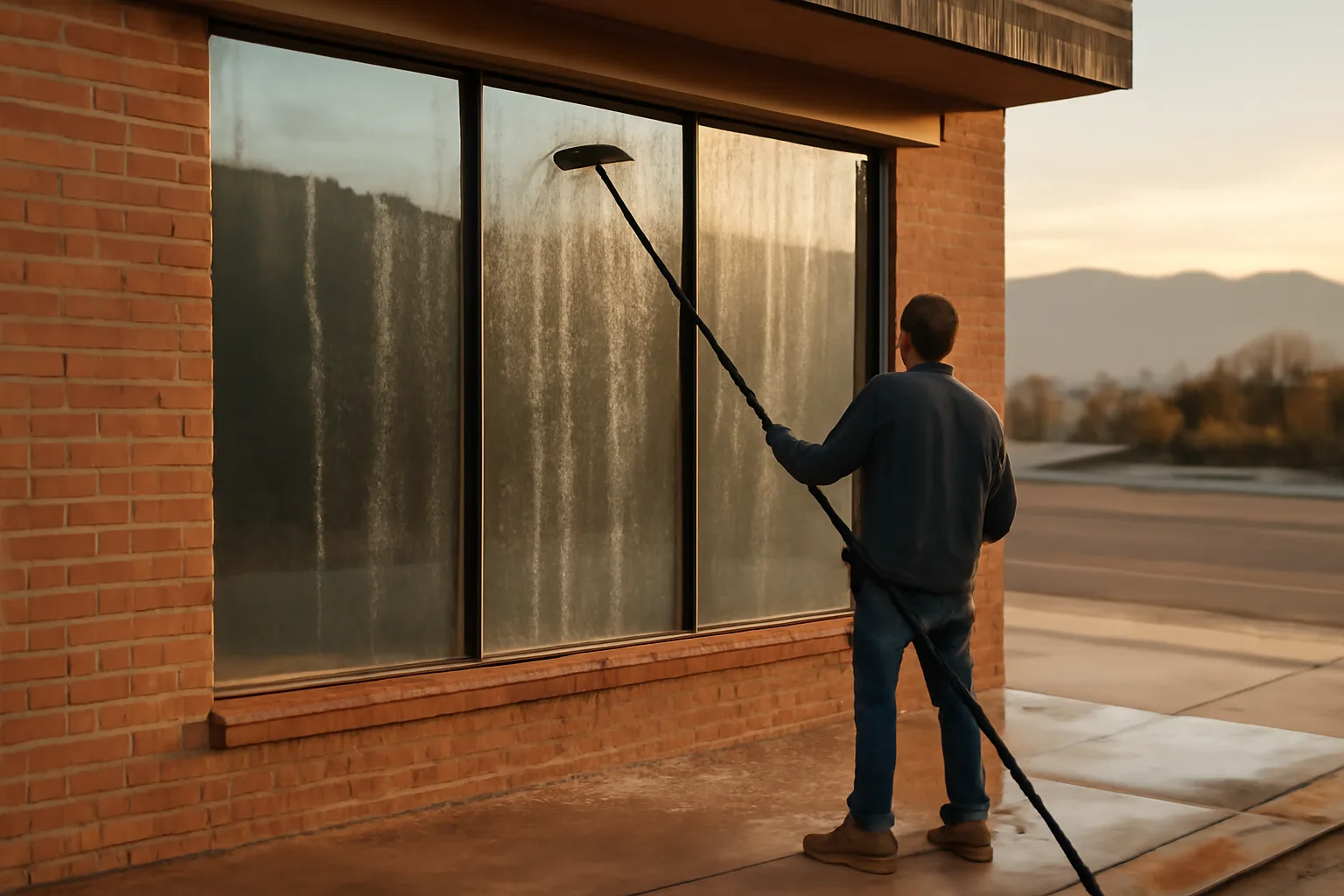
A water-fed pole from the sidewalk keeps most storefront work below that trigger. Step onto a canopy, a mezzanine, or a storefront ledge and you are in 1910.28 territory.
I would not send a new hire up a folding ladder onto a two-story transom to save a pole extension. The time you save is not worth the report. Ground-based poles exist for a reason. Mid-route, a simple water-fed kit (StorefrontWash sells a $149 one-time Pure-Water Pole Route Kit) is optional gear, not a license and not fall protection.
Ladders on ice are how winter routes go stupid. Reschedule. The account will still be there on Thursday.
What payroll, leave, and hiring rules hit a Colorado window crew?
The day you hire, you leave the solo stack. CDLE wage and hour rules apply [12]. You post the current statewide minimum wage, unless a local rate like Denver's is higher, in which case you post and pay that one [3]. You register for unemployment insurance through CDLE. You withhold. You report new hires.
FAMLI is not optional folklore. Colorado's Family and Medical Leave Insurance program requires employers with employees to participate, with the details and current premium on the FAMLI employer pages [5]. Confirm the split and the wage base there. Do not copy a 2024 Slack message.
Paid sick leave is statute, not a perk. The Healthy Families and Workplaces Act requires covered employers to provide paid leave, and the standard accrual CDLE describes is 1 hour of leave per 30 hours worked [6]. That 1-per-30 figure is the one I would put in the handbook, then I would reread the current CDLE HFWA page when the poster updates.
Misclassification is how small routes blow up. A Saturday helper who uses your pole, drives your van, and only works your list looks like an employee to people who write citations. I would hire W-2 for crew and keep true contractors for rare work you do not control.
If you will never hire, skip this pile. Do not register payroll accounts for a future that is not real. You can open them in a week when the first employee is actually coming.
How long does the paper path take in Colorado?
The federal and state pieces you control can be fast. An EIN application is free and online [8]. SOS formation and a trade name are online if you have a card and a unique name [9]. I will not promise a clock. Portals stall. Names get rejected. That is normal.
City licenses are the long pole. Denver Excise and Licenses is its own queue [10]. A mountain town clerk may hand you a form at the counter. Same state, different week. Ask that office for the current intake steps and believe their answer, not a Facebook group.
Insurance binders depend on your loss history and the underwriter. A clean new GL policy can be quick. A workers' comp policy for a crew that lists heights takes more questions [4]. Answer them. Do not hide the second-story work.
I would not delay selling until every portal shows a green check. I would delay the first paid job until EIN, a bank account, GL, and the city license for that job's town are real. Working a Denver stop on an Aurora-only plan is how you redo invoices.
Keep a winter route out of state and do not assume the Colorado stack ports. Storefront windows renewal in Tennessee: licenses, costs, and timelines will not match this list, and neither will storefront windows renewal in Illinois.
What would I actually do in year one on storefront windows in Colorado?
I would pick an entity or a clean sole-prop trade name, grab the free EIN, open a dedicated bank account, and buy general liability before I printed a single hanger [8][9]. I would check Denver or whatever city holds my first ten doors [10]. I would skip any vendor selling a statewide window license.
I would learn 29 CFR 1910.28 and keep the work on the pole from the ground whenever the building allows it [1]. I would not dump soapy buckets into a storm inlet. Colorado cities sit under MS4 stormwater programs, and wash water in the gutter is how you pick a fight you do not need [14]. Pure water and a sewer drain (with the manager's OK) is the boring, correct habit.
I would price a tight downtown loop, not a 90-minute windshield tour. I would read the current CDLE and Denver wage posters before I hired anyone [3]. I would put the SOS periodic report month on a calendar the same day the entity number arrives [9].
Waste of money: laminated fake licenses, lead lists of every dentist in the state, and a wrap on a van you still park in a driveway. Useful: a hose-reach plan, a COI template, and a route that fits between school drop-off and the lunch rush.
Want a start checklist after this page? The start path is at /start. StorefrontWash is an independent publisher, not a law firm and not a service company. Confirm fees, forms, and processing with the board that takes the money. storefront windows renewal in Florida and storefront windows renewal in Alabama are separate stacks if you ever add those states.
Frequently asked questions
Do you need a license for storefront windows in Colorado?
You do not need a statewide occupational license to wash storefront glass. Colorado does not examine or card window cleaners. You may still need a city or town business license, a trade name filing, and an EIN. Denver uses Excise and Licenses. Confirm the town on each stop before you invoice. A bought online contractor card is not a Colorado credential.
How much does storefront windows cost in Colorado?
There is no official statewide price. Small recurring storefront visits often land in the low hundreds of dollars, then rise with interiors, height, and neglected glass. BLS wage data for building cleaners is the closest official labor input, and Front Range pay usually runs above the national median. Build the bid from hours, local minimum wage, insurance, and drive time.
How long does storefront windows take in Colorado?
A practiced tech often finishes a small single-story face in 20 to 45 minutes with a water-fed pole if parking and water access are honest. First visits take longer. Interiors, tracks, and real height add a full appointment. No trustworthy Colorado time study exists. Sell a time window, not a fake minute count. Paper time at city counters is a separate, unpredictable wait.
Is there a Colorado state contractor license for window cleaning?
No. The Department of Regulatory Agencies licenses named trades. Window cleaning is not one of them. Formation with the Secretary of State is not a contractor license. A city business license is not a contractor license either. If a website sells you a Colorado window contractor number, you are buying a product that does not match a state board.
How do you renew a Colorado LLC used for a window route?
You file the periodic report with the Secretary of State on the cycle assigned to that entity and pay the fee on the current SOS business fee schedule. Keep the registered agent address true. Local licenses and insurance renew on their own calendars. Confirm the due month in your SOS account. Do not wait for a landlord to notice bad standing.
Do you need workers' comp as a solo storefront window washer?
A true solo operator with no employees is not in the same bucket as a crew. Colorado still expects employers to cover employees. Officer exclusions exist on paper with the carrier and the Division of Workers' Compensation, not as a handshake. Confirm your facts on the CDLE DWC employers page and in the policy. Do not guess after a helper starts.
Is window cleaning taxable sales in Colorado?
Often a pure wash is sold as a service, and Colorado taxes goods more than most services. Home-rule cities can write a different tax base. If you sell products, you likely need a sales tax account. The state rate is 2.9 percent before local add-ons. Ask the Department of Revenue and the city finance office about your exact mix. Do not copy a forum answer.
What is the Colorado periodic report?
It is the annual (or otherwise assigned) entity report the Secretary of State requires to keep an LLC or corporation in good standing. It is not a window-cleaning license renewal. Fees live on the SOS business fee schedule. File it in the assigned month. Late filing is how a cheap report becomes a reinstatement project and a problem on a vendor packet.
Do you need a Denver license if you already filed with the state?
A Secretary of State filing does not replace a Denver business license. Denver Excise and Licenses runs its own process. If the work and the billing sit in Denver, check that department before the first invoice. Other cities are separate. One statewide entity number will not satisfy every clerk on the Front Range.
Can you use a water-fed pole from the sidewalk in Colorado?
Usually yes for ordinary storefront height, and it keeps people off ledges that trigger OSHA's 4 foot fall rule. Watch right of way rules if a ladder or hose blocks a sidewalk or bus lane. Do not put wash water into a storm inlet. Ask the manager where wastewater should go. Confirm any street-use permit with that city's public works desk.
Does Colorado require a surety bond for storefront window cleaning?
There is no statewide window-cleaning surety bond. A property manager can still demand a certificate of insurance, additional insured language, or a higher limit. Meet the vendor packet in front of you. Buying a random bond because a national checklist mentioned one is usually a waste. Ask the landlord what they actually require.
What if you only wash storefront windows on weekends?
Part-time work still needs the same legal identity, insurance, and city checks as a weekday route. OSHA still applies to employees. Local minimum wage still applies if you hire. The SOS periodic report still comes due. Weekend-only is a schedule, not an exemption. Keep the paper stack small, but keep it real.
How often do you file Colorado sales tax if you have an account?
The Department of Revenue assigns a filing frequency when the account opens. It can be monthly, quarterly, or another schedule based on their rules, not your preference. File even if a period is zero when they told you to file. Confirm the assigned frequency inside your Revenue Online account. Do not invent a quarterly habit if they set you to monthly.
What insurance limits do Colorado property managers usually ask for?
Limits live in the lease and the vendor packet, not in a window statute. Many commercial packets ask for general liability at a round commercial figure and extra insured wording. Some add auto and workers' comp proof. I would read the packet before I bind a cheap policy that misses the additional-insured form. Confirm the number they printed, then buy that, not a blog average.
Sources
- OSHA 29 CFR 1910.28 Duty to have fall protection: Employers must protect employees on walking-working surfaces with an unprotected edge 4 feet or more above a lower level
- Colorado CDLE Minimum Wage: Colorado publishes a statewide minimum wage that employers must follow unless a higher local rate applies
- Colorado CDLE Division of Workers' Compensation, Employers: Colorado expects employers to carry workers' compensation coverage for employees
- Colorado FAMLI program, Employers: Colorado FAMLI requires employer participation and premium handling when you have employees
- Colorado CDLE Healthy Families and Workplaces Act: HFWA requires paid leave and describes standard accrual of 1 hour per 30 hours worked
- Colorado Department of Revenue, Sales tax rates: Colorado's state sales tax rate is 2.9 percent before local add-on rates
- IRS, Apply for an Employer Identification Number (EIN) online: The IRS does not charge a fee to apply for an EIN online
- Denver Department of Excise and Licenses: Denver requires many businesses to hold a license through the Department of Excise and Licenses
- BLS Occupational Outlook Handbook, Janitors and building cleaners: BLS publishes median pay for janitors and building cleaners, the closest official wage input for cleaning labor models
- Colorado CDLE Wage and Hour Law: CDLE administers Colorado wage and hour rules that apply once you hire employees
- Colorado CDPHE, Municipal Separate Storm Sewer System (MS4): Colorado municipalities operate MS4 stormwater programs that restrict what may enter storm drains